Tesla's V12 Full Self-Driving release was a genuine leap for autonomous driving. Here is how Tesla got there, and what I think comes next.
From isolated systems to end-to-end
In the early days of autonomous driving, each function (steering, acceleration, perception) was developed in isolation. The modular approach allowed fine-tuned control, but it was too rigid for the unpredictability of real-world traffic. The real breakthrough came with end-to-end training.
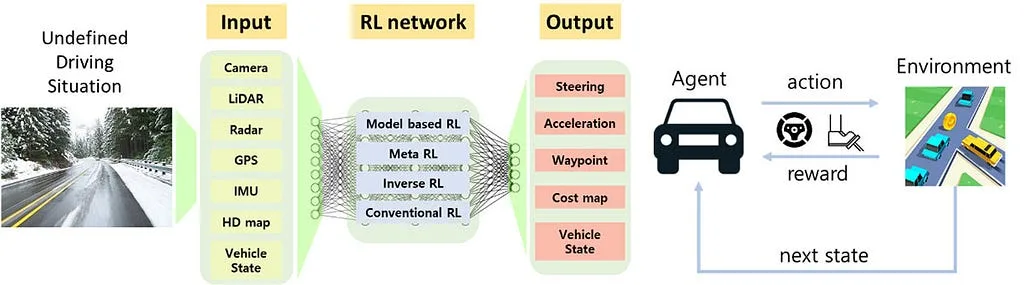
In version 12, Tesla dropped the isolated modules and moved to end-to-end training for its self-driving system. Instead of hand-written rules, large neural networks train on real-world human driving data, taking in all camera feeds and learning to get from point A to point B the way a human would. This changed how autonomous driving gets developed: behavior now comes from data instead of engineers encoding edge cases one by one.
Shoutout to comma.ai, who predicted this shift years ago.
Personalized driving experiences
Tesla's self-driving has reached a point where the remaining complaints are often about personal preference rather than technical failure. Some drivers prefer a faster pace, others a more relaxed one.
Tweaking specific behaviors in a neural network is hard because of its black-box nature. Fine-tuning offers a way around that.
Fine-tuning means taking a pre-trained model and adapting it to a specific task with a smaller, task-specific dataset. The model picks up the nuances of the new task without being retrained from scratch.
Applied here: in the future, each car could ship with multiple base driving models, and after, say, 100 kilometers of driving, the system adapts to your personal style. The result would be a car that drives exactly like you would, just at a superhuman level.
It sounds like science fiction, but my prediction is that this is the way forward.