
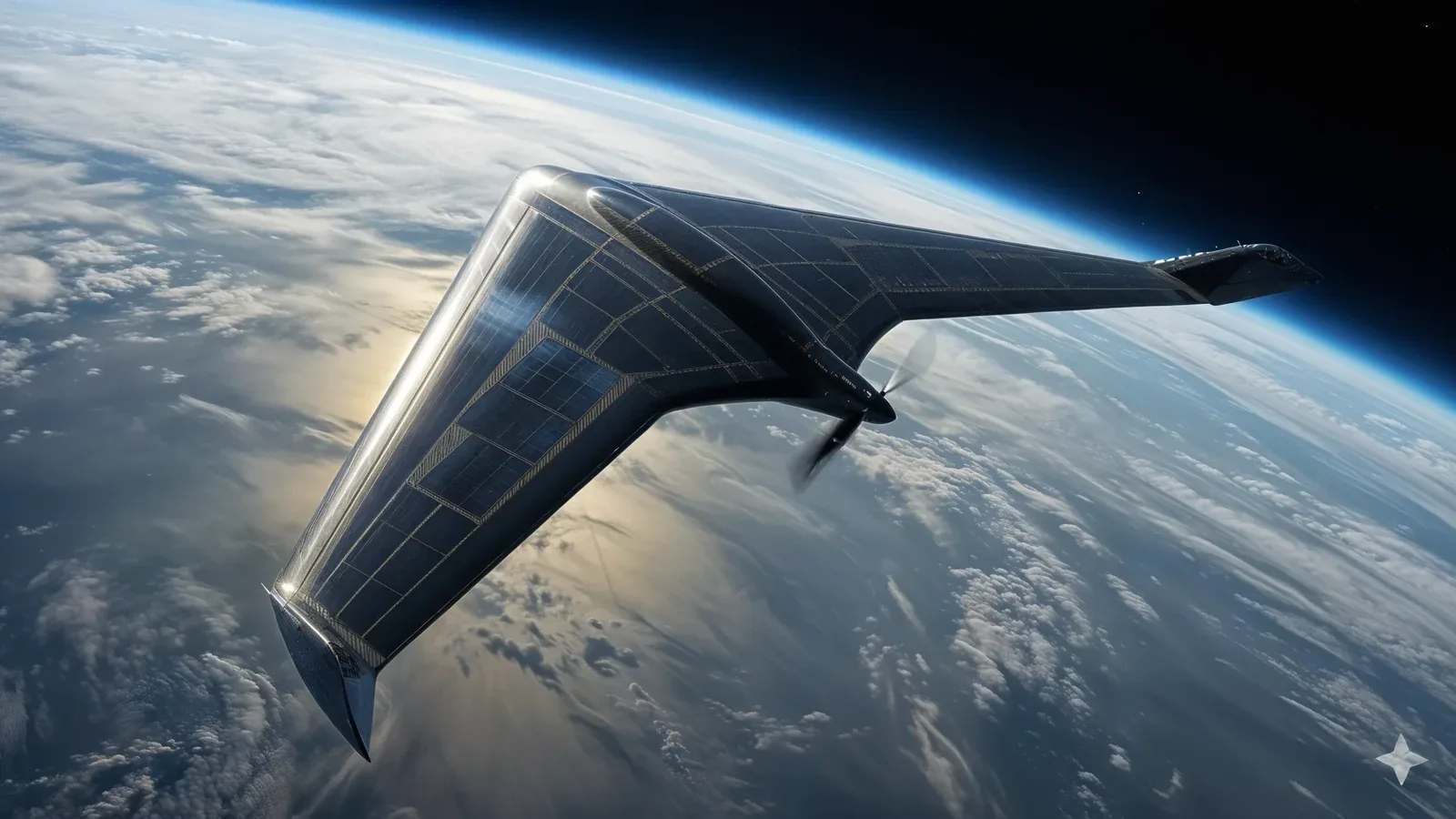
I have spent the last few months reading everything I could find about aircraft that are meant to sit above a country for years at a time without landing, and then sketching one myself to see whether the numbers close. They mostly do, which was not the result I expected. Along the way I stopped believing that satellites are the endgame for connectivity, and I want to explain why, including the half of the argument I left out the first time I wrote this down, which is who is actually paying for any of it.
The short version: there is a band of atmosphere between 20 and 25 kilometres altitude that nobody is commercially using. Not aviation, which tops out around 15 km. Not satellites, which start at 200 km and get interesting at 550. The stratosphere in between is empty, barely regulated, and physically closer to the customer than any orbit will ever be. Aircraft that live up there are called HAPS, high altitude platform stations, or high altitude pseudo satellites if you like the marketing version. They do the job of a satellite without the rocket.
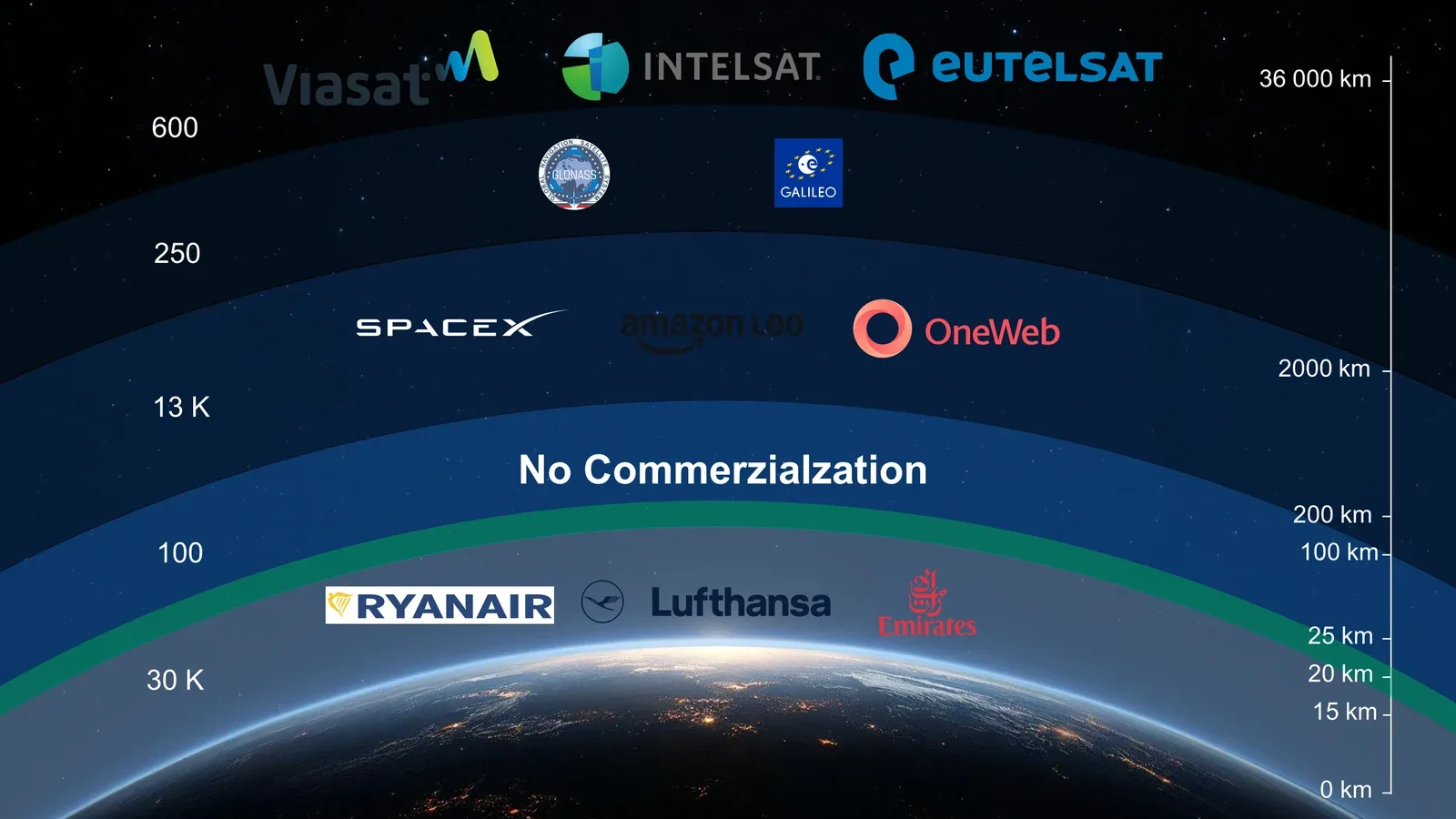
Distance is the whole argument
A LEO satellite orbits at roughly 550 kilometres and moves at 7.6 km/s, which means it is over your head for a few minutes before it hands you to the next one. A HAPS sits at 20 kilometres and stays there. That single difference cascades through everything else.
Link budget scales with the square of distance. Going from 550 km to 20 km is a factor of 27 in range and roughly 750 in free space path loss. That is why a HAPS can talk to an unmodified phone using ordinary terrestrial mobile spectrum, while direct-to-cell from orbit needs enormous satellite antennas and still delivers a texting-grade link.
Latency is worth being careful about, because the obvious version of the argument is wrong. Propagation to 550 km and back is only 3.7 ms, so distance is not what makes satellite internet feel slow. The delay comes from the hop through a ground gateway and the routing behind it. Starlink now reports a median peak-hour latency of 25.7 ms in the US and is targeting a stable 20 ms, with third-party measurements clustering between 25 and 50 ms. Sceye reports end to end network latency below 20 ms from the stratosphere. So the HAPS advantage on latency is real but modest, a handful of milliseconds rather than the order of magnitude the altitude difference might suggest. The 0.13 ms round trip to 20 km matters because it removes propagation as a design constraint entirely, not because it wins a ping contest.
Then there is what happens per unit of capacity. A satellite illuminates a cell hundreds of kilometres wide and shares that capacity across everyone in it, which is exactly why Starlink performs well in empty countryside and degrades in any area where subscribers cluster. A study cited by Light Reading concluded that even with the terabit-class V3 satellites arriving this year, Starlink remains best suited to low density markets. That is not a bug they will fix with more launches. It is geometry. From 550 km you cannot make your beams small enough to reuse spectrum the way a network on the ground does. From 20 km you can.
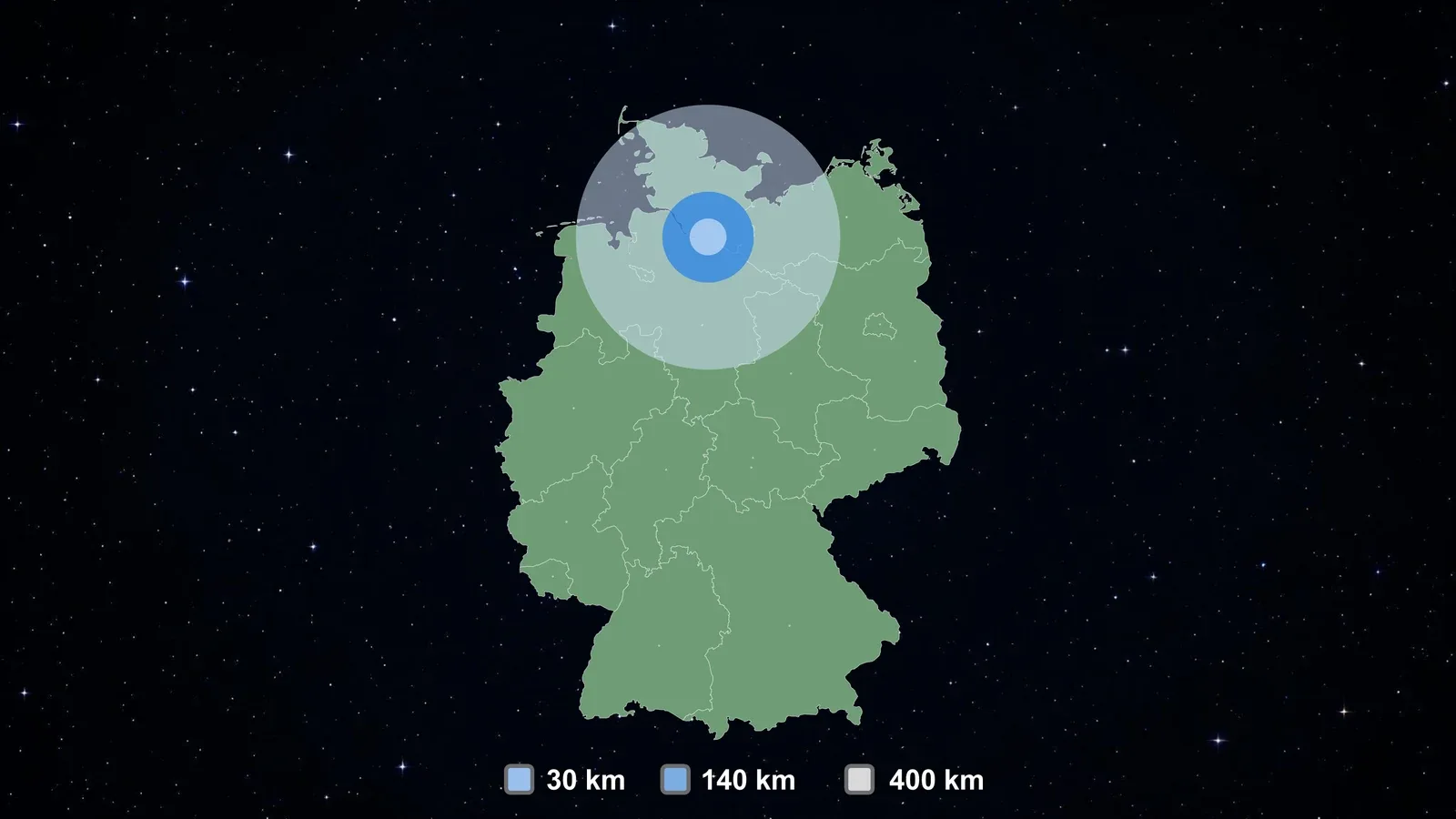
What the geometry gives you is concentric rings rather than one uniform footprint. Directly underneath, the look angle is steep and the link is short, so you get broadband. Further out the angle shallows and the range grows, so you get ordinary 4G and 5G. Further out still the link only supports things that tolerate a weak signal, which is exactly what IoT sensors, machine to machine traffic and messaging are.
The obvious thing to do next is count how many ground masts one platform displaces. That number turns out to depend entirely on which question you are asking, so it is worth writing both down side by side.
| Zone | Diameter | Masts matched by area | Masts matched by throughput |
|---|---|---|---|
| Core, broadband | 30 km | around 23 | 1 to 10 |
| Service, 4G and 5G | 100 km | around 240 | 1 to 10 |
| IoT frontier | 400 km | around 980 | 1 to 10 |
The throughput column is identical in every row, and that repetition is the finding rather than a mistake. Coverage is a property of altitude, so it grows with the square of the radius as you accept a weaker link. Capacity is a property of the payload, so it does not grow at all. A gigabit-class platform holds about as much traffic as one well-equipped 5G macro site, where 64-element massive MIMO can reach into the multi-gigabit range on its own, or a handful of modest rural ones. Seeing more ground does not give you more spectrum. The area column also flatters the outer ring, which only reaches those numbers by assuming much larger cells than the inner two.
That asymmetry is why my own slides managed to contain both "replaces 238 masts" and "replaces up to 10 masts" without either being a lie. They answer different questions. Sell coverage and the honest number is in the hundreds. Sell capacity and it is in the single digits. Quoting the coverage number while implying the capacity number is the central dishonesty available in this industry, and it is mostly self-inflicted.
Which points at what HAPS are actually for. Blanket reach where reach is the product, meaning rural white spots, IoT, maritime, disaster response and emergency restoration, is a real business that altitude wins outright. Replacing a carrier's radio access network in a populated area is a different business, and geometry says you would need a fleet, not an aircraft.
Why this is happening now and not in 2016
Google's Project Titan and Facebook's Aquila both died, and their failure is still the reason most people dismiss the category. Those projects were not wrong about the concept. They were early on four curves that have since crossed.
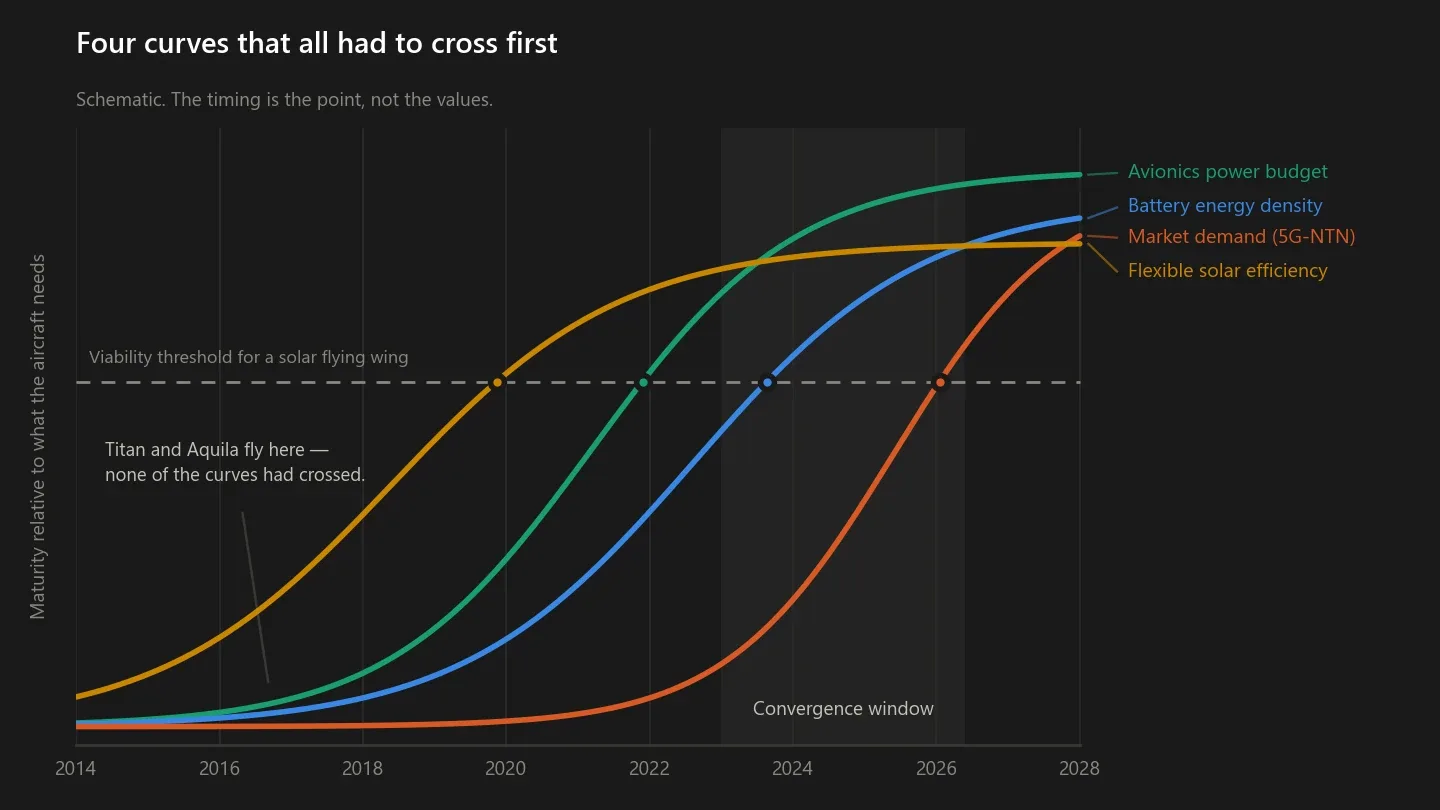
Battery energy density went from around 250 Wh/kg to 450 Wh/kg, and lithium-sulfur pushes past that. This is the one that matters most, because a solar aircraft lives or dies on whether it can carry enough energy through the night. Sceye flew its 12-day endurance mission in March 2026 on lithium-sulfur cells specifically for this reason.
Flexible solar cell efficiency roughly doubled, from about 10% to 24% for cells you can actually laminate into a curved wing surface rather than mount on a rigid panel.
Flight control moved from 100 W of avionics to about 10 W, because the compute that keeps a 35-metre flying wing stable in stratospheric turbulence now runs on chips designed for phones.
And the demand side changed shape entirely. In 2016 the pitch was 4G for the unconnected, which is a development-aid business. Today it is 5G non-terrestrial networks, which is a line item in every major carrier's roadmap.
Sizing an aircraft that never lands
You do not design this aircraft starting from the wing. You start from the worst night of the year, because everything else is downstream of whether the batteries make it to sunrise, and that single constraint produces the rest of the vehicle almost on its own.
Mine came out as a 35-metre flying wing at 150 kg maximum take-off weight, monoplane, high aspect ratio, FX 63-137 profile. The mass fractions are where it gets interesting: 45 kg of airframe, 60 kg of batteries, 15 kg of payload. The batteries are forty percent of the aircraft and the payload, which is the entire reason the thing exists, is ten. That ratio is the tyranny governing every design in the category, because a kilogram of payload needs battery to run it, battery needs wing to carry it, wing needs structure to hold it, and structure needs more wing. It is why these aircraft all look like gliders that got stretched, and why nobody has built a small one. Reassuringly, those numbers land almost exactly on PHASA-35, which is a real aircraft that really flies, so the sizing is not fantasy.
The airfoil choice follows from something unintuitive about 20 km. The air is thin, about seven percent of sea level density, which helps enormously with drag but also means the wing works at a Reynolds number of only a few hundred thousand. That is model-aircraft territory rather than airliner territory, and most standard profiles behave badly there because the boundary layer separates before it can transition. The FX 63-137 is a high-lift low-Reynolds section drawn in the era of human-powered aircraft, which is more or less exactly this regime.
The other structural problem is that the solar cells cannot sit on top of the wing. They have to be inside it, flush with the aerodynamic surface, or the drag penalty eats the entire energy budget. That means laminating cells into a composite layup with an EVA encapsulant that flows into the gaps between cells without printing their outline through the outer ETFE skin.
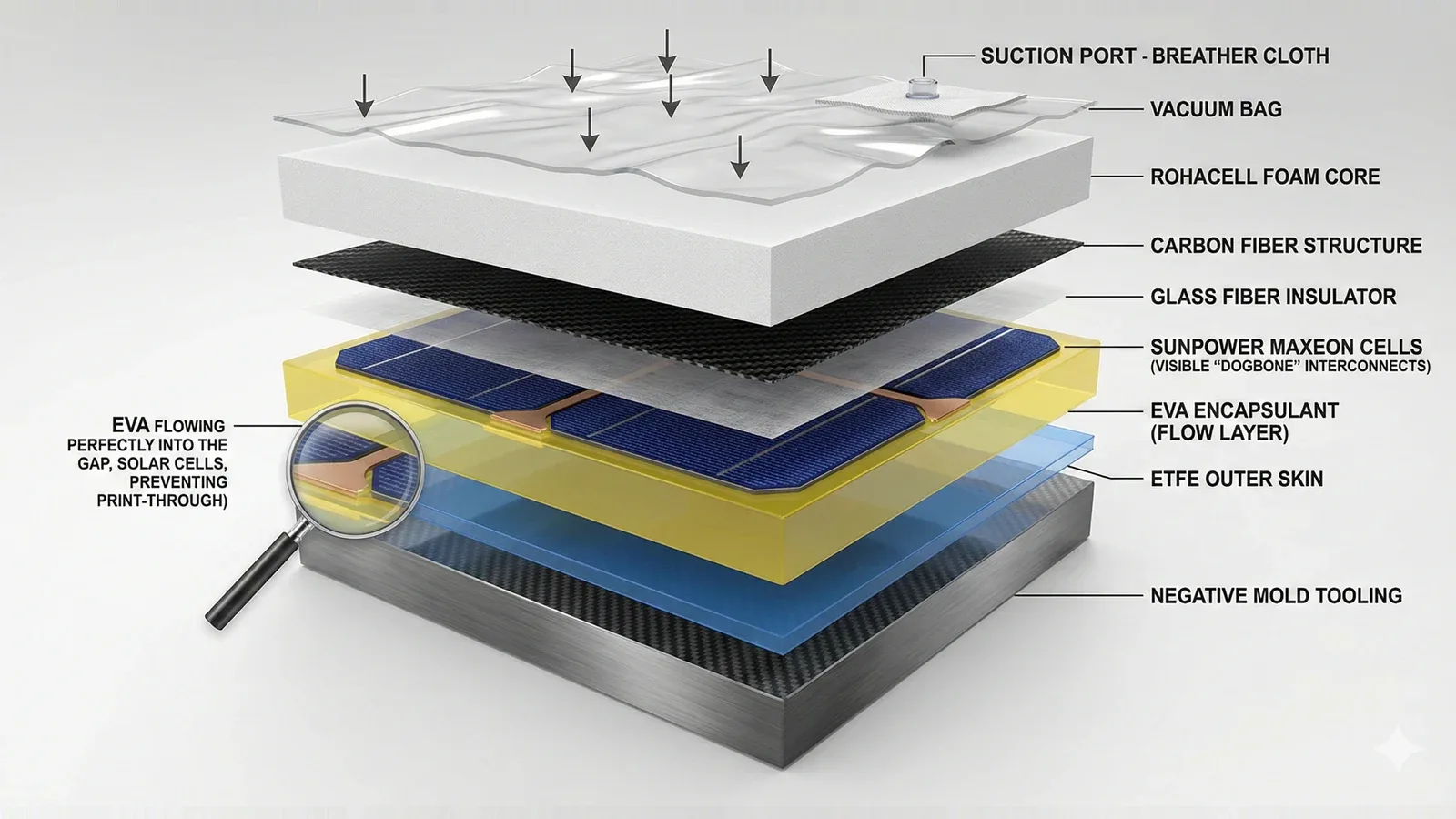
Print-through reads like a cosmetic worry until you work out what it does aerodynamically. A surface that faithfully reproduces the outline of every cell underneath is a surface covered in hundreds of small steps, and at this Reynolds number those steps trip the boundary layer and cost you the laminar flow the whole airfoil choice was for. The encapsulant is doing aerodynamic work, not just adhesive work.
Get that right and 28 m² of wing surface produces about 6.7 kW peak at 24% system efficiency. For calibration, Aiko's back-contact modules reached 25.6% in mass production this year on rigid glass, so 24% across a curved laminated wing looks defensible rather than a stretch target.
The engineering problems are real, and they are thermal
The part I find most interesting is not aerodynamics. It is heat.
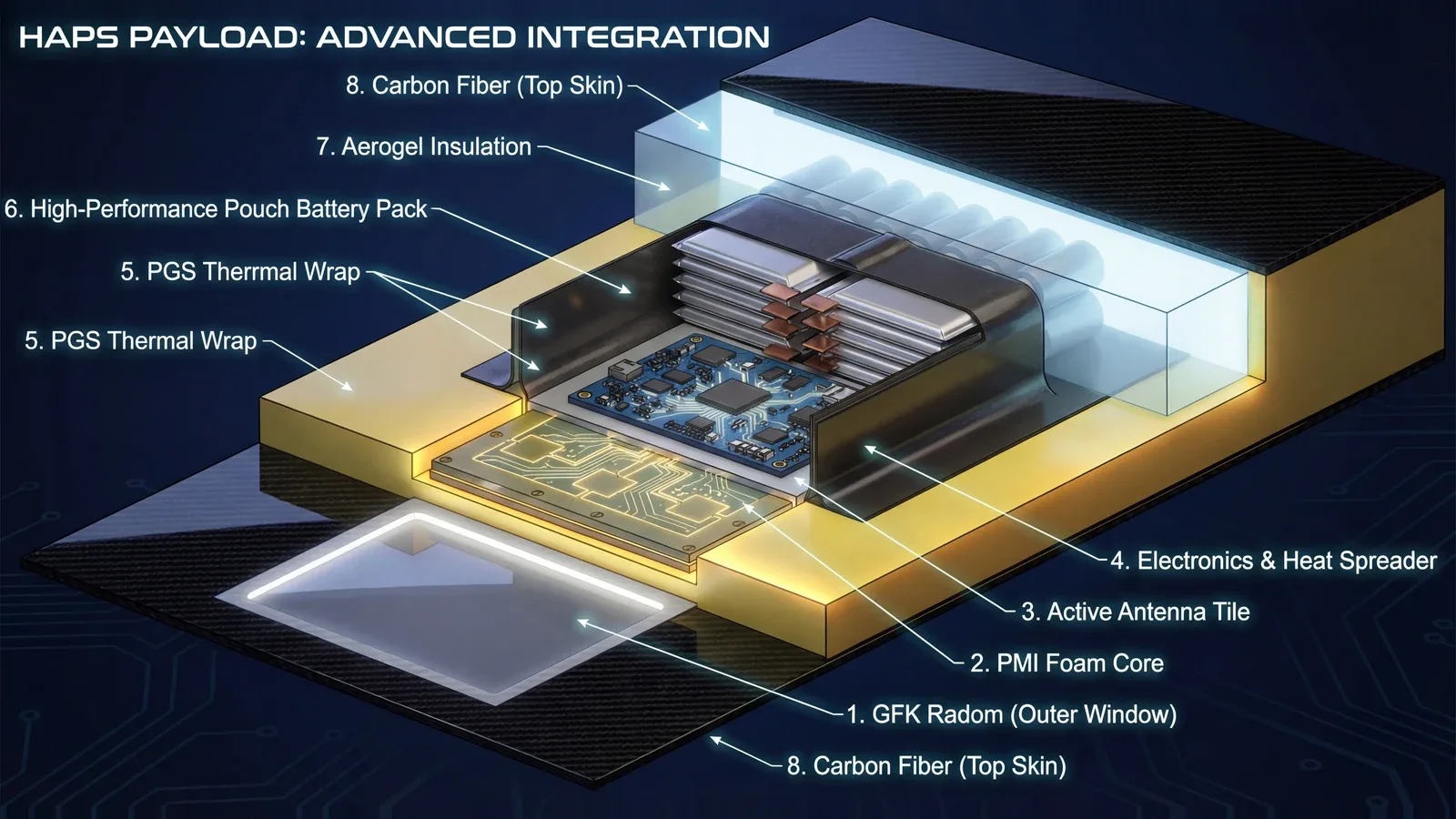
At 20 km the standard atmosphere sits at about -56°C, real conditions run between -55 and -65°C, and you design the thermal system against roughly -70°C so it still closes on a bad winter night. The air up there is thin enough that convective cooling barely works. So you have two contradictory problems at once. Your batteries want to be at roughly 20°C or they lose a large fraction of their usable capacity, and your radio payload is dumping hundreds of watts of waste heat with almost no air to carry it away. Most designs solve these separately, with a heating system for the batteries and a cooling system for the electronics, and pay twice in mass and power.
The approach that interests me most couples them. Pyrolytic graphite sheets move roughly 350 W of waste heat out of the 5G electronics and into the battery core, the whole assembly wrapped in aerogel insulation. The electronics stay cool, the batteries hold temperature, and the heating power budget is zero because the heat was already being generated. The wing structure itself does triple duty as airframe, enclosure and thermal path.
Altitude as a battery
There is one trick available at 20 km that has no orbital equivalent, and it changed how I think about the energy problem.
Potential energy is free storage. Instead of sizing the battery pack for a full night of level flight, you climb during the surplus hours of the afternoon and convert excess solar into altitude, then glide back down through the night while the propellers idle. The aircraft trades 4 kilometres of height for hours of endurance.
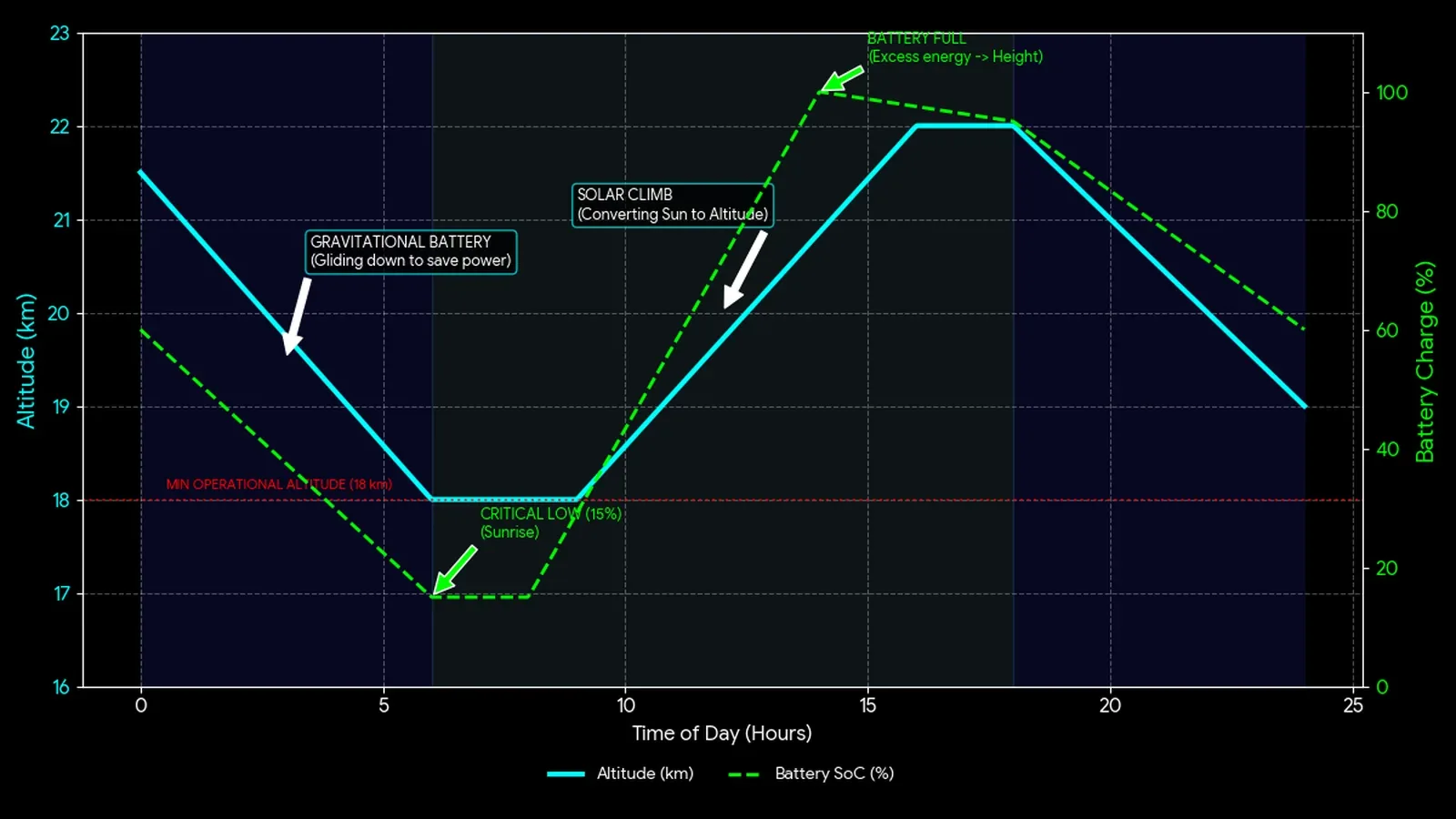
The profile above is the winter case, which is the hard one. The aircraft bottoms out at 18 km and 16% state of charge right at sunrise, then climbs back to 22 km as the sun comes up. A satellite in eclipse has no equivalent move. It draws down the battery and that is the end of the conversation. Sixteen percent is also not a comfortable margin, and it is the number that says this design has no room at all for a heavier payload.
That power budget is where the honest problem lives, and it is not the airframe. Every concept in this space, mine included, assumes a radio payload delivering gigabits from a few hundred watts. What has actually flown is nothing like that. Zephyr's Kenya trial connected a handset at a few megabits per second, and SoftBank's field-trialled payload carries six cells. Reaching gigabit capacity means many more beams reusing the same spectrum, and a terrestrial radio of that class draws more power on its own than a solar aircraft's entire payload allowance. Flying for a year is close to solved. Flying with a base station worth talking to is not, and that is the gap the whole category has to close.

To be clear, I am not building it. No factory, no certification path, no intention of starting an aerospace company. It was a paper exercise to find out whether the physics closes, and the useful result is that the aircraft was never the hard part. The radio payload is.
The economics are structural
The cost argument does not rest on anyone's spreadsheet, which is why I find it more convincing than the revenue side.
A ground network is capital you have to pour before it earns anything. Each mast is a foundation, a power connection, a fibre run, a lease and a permit, and in Germany the permit is usually the binding constraint rather than the money. You spend for years, then start collecting. A HAPS inverts the order. There is no ground segment to build, so the spending tracks the service rather than preceding it, and because the asset flies, coverage moves from one region to another for the cost of a flight plan. An infrastructure build becomes something closer to a leasing business.
The same asymmetry shows up against satellites, from the other direction. A constellation has to be most of the way complete before it serves anyone, because coverage comes from the whole fleet passing overhead rather than from any single spacecraft, and it has to be continuously replaced as satellites deorbit. A HAPS fleet scales one unit at a time, and a unit lands for maintenance instead of burning up.
The regulator already moved. WRC-23 allocated global spectrum for HAPS acting as mobile base stations in the 694 to 960 MHz, 1710 to 1885 MHz and 2500 to 2690 MHz bands. That is the important detail hiding in a boring acronym. HAPS were given permission to use the same frequencies as terrestrial mobile networks, which means a HAPS is not a competing system a carrier has to integrate. It is a cell in their existing network that happens to be flying.
Nobody in this category has died of aerodynamics
Loon is the case everyone remembers, and most people remember it wrong. It was not a technical failure. Loon reached commercial service in Kenya in July 2020 with roughly 35 balloons covering nearly 50,000 square kilometres, selling connectivity to paying customers, and Alphabet shut it down six months later because the road to commercial viability was longer and riskier than they had hoped and the costs would not come down far enough to build a sustainable business. The balloons worked. What did not work was the arithmetic underneath them.
The size of that gap is worth naming. In the post-Loon reckoning, HAPSMobile was targeting a price point of one dollar per user per month, which meant getting aircraft cost from around $6.8 million down to roughly $1 million. That is not an efficiency programme, it is a factor of seven on a vehicle that has to survive years in the stratosphere.
Titan, Aquila and Loon all died, and not one of them died because the aircraft would not fly. Which means that when I satisfied myself that the physics closes, what I had actually proved was the less interesting half of it.
Who is actually paying
The money that has arrived since is more interesting than the money that left, mostly because of its shape.
Sceye took a strategic investment from SoftBank Corp as the first tranche of its Series C, bundled with an exclusive arrangement for stratospheric services over Japan, so a carrier took equity and bought a territory in the same transaction. Aalto, the Airbus spin-out flying Zephyr, raised $100 million from a Japanese consortium led by NTT Docomo and Space Compass, with Mizuho Bank and the Development Bank of Japan alongside, pointed at the same market on the same logic. Two flagship programmes, both funded by national carriers buying rights to their own sky, which is not venture capital waiting for a consumer breakout so much as infrastructure procurement wearing a venture costume. It also settles the question of who the customer is, and it is not the person holding the phone.
Avealto is running a smaller version of the same play from the other end of the market. The British company opened a $50 million round in July to fund a factory at Lydd Airport in Kent and a first commercial network in Southeast Asia, with talks in Malaysia and an Indonesian memorandum behind it, and their own framing gives the model away: capacity delivered into a telecom operator's network rather than competing with it for subscribers, priced at roughly 80% below wholesale satellite rates. Their claimed footprint also happens to check my table above, since 45,000 square kilometres per platform is a circle about 240 km across, sitting between my 100 km service ring and my 400 km IoT frontier.
Then there is the money that never appears in a connectivity deck at all. PHASA-35, built by BAE's Prismatic subsidiary, won a multi-year AFRL surveillance contract for months-long missions in coordination with US Southern Command, and defence does not care about dollars per subscriber per month. It cares about persistent stare, and it will pay for flight hours at prices no telecom business case could ever justify.
So there are three ways to get paid in this category and none of them is selling internet to people. A national carrier buys the sky over its market and takes equity to make sure it stays bought. A platform operator sells wholesale bits into existing networks at a discount to satellite. Or a defence customer pays for endurance while the telecom case matures. The third is what quietly funds the first two, because surveillance contracts buy the flight hours, the certification evidence and the reliability record that any carrier will want before it hangs a commercial service off a solar aircraft.
The 67 days that ended in the Indian Ocean
The reality check arrived this year, and Aalto published it rather than burying it. Zephyr launched from Kenya on 20 February and stayed up for 67 days, a world record, and on 28 April the aircraft was lost, ditched in the Indian Ocean. The 2022 vehicle had gone the same way after 64 days, breaking up in severe turbulence as it came down out of the stratosphere into the much denser troposphere.
Twice now the flight has been fine and the descent has not, which is a consequence of the design rather than bad luck. An aircraft optimised to fly at seven percent of sea level density is enormously light for its span, and getting it back means flying it down through weather it was never built for.
Aalto held its 2026 commercial target anyway, and the path they describe is the part worth reading closely: UK CAA type certification, customer mission delivery, and a second AALTOPORT in northern Australia. None of those is an aerodynamic problem. The schedule is set by a regulator, a customer and a piece of ground infrastructure, which is Loon's lesson arriving from a different direction.
The Kessler argument nobody wants to have
There is also a risk case, and 2026 made it much harder to wave away.
ESA's Space Environment Report this year recorded a 20% jump in collision probability in low Earth orbit, and several heavily used altitude bands above 600 km have passed the density threshold where collisions generate debris faster than the atmosphere clears it. Starlink satellites performed more than 355,000 collision avoidance manoeuvres in the past year, over three times the 2024 figure. In one recent stretch that worked out to a manoeuvre every two minutes across the fleet. The FAA withdrew its 25-year disposal rule in March, so the governance gap widened at exactly the wrong moment.
I am not predicting a cascade. I am pointing out that the world has quietly made a very large bet that one specific altitude band stays usable, with no fallback. HAPS operate at 20 km, four hundred kilometres below the debris, inside an atmosphere that cleans itself. If LEO degrades, stratospheric infrastructure is the only layer that can carry the traffic. If it does not degrade, HAPS still win on latency, spectral efficiency and cost per covered square kilometre in populated areas.

There is a political version of the same argument. When Ukraine's drone operations depended on Starlink access, that access depended on decisions made by one person. A network you can rebuild from a hangar in your own country is a different kind of asset than a network you rent from a constellation you cannot influence.
Where this actually stands
The honest status: nobody has flown a commercial HAPS service yet. What changed in 2026 is that the flight durations finally met the commercial requirement.
Sceye's SE2 covered 6,400 miles over 12 days in March, from New Mexico to the Brazilian coast, holding station within a 1 km radius for 88 hours and getting through four consecutive day-night cycles. That was the last technical question mark, and the company has moved on to pre-commercial flights, the first of them in Japan providing backhaul into SoftBank's core network. Aalto is doing a commercial demonstration over Japan this year with NTT Docomo. SoftBank is putting a pre-commercial airship up as a 4G and 5G tower. BAE's Prismatic flies PHASA-35 for surveillance work, Kea Aerospace is going after Earth observation, Mira Aerospace under Space42 is building large platforms for civil and defence customers.
That is five or six serious programmes, all converging on the same 18 to 25 km band in the same 18 months. When a category that failed twice suddenly has that many credible teams reaching flight-qualified endurance at once, the reason is usually that some underlying constraint moved. In this case four of them moved.
I would treat every market forecast in this sector with suspicion, including the one I first wrote down myself. Published 2030 estimates for high altitude platforms differ by more than an order of magnitude depending on whether you count airships, tethered balloons and defence surveillance alongside commercial telecom. A spread that wide is not an estimate, it is an admission that nobody knows yet, which is what you would expect of a category with no commercial service running. I am also deliberately not putting a revenue model here. Anyone can build a spreadsheet that turns one aircraft into a good business, and since nobody has flown a commercial HAPS service, all of those spreadsheets are fiction of one sort or another. The cost structure is the part that is not fiction, and it points at the stratosphere.
Both halves of this ended up in the same place, which I did not expect when I started. The engineering exercise says the airframe closes and the payload does not. The business history says nothing here has ever died of aerodynamics, it dies of cost per delivered bit. Those are the same finding wearing different clothes. HAPSMobile needed a factor of seven on aircraft cost to reach a dollar a month, my design needed a radio that does not exist to justify its fifteen kilograms, and in both cases the gap between what a platform costs and what it can carry is the entire proposition. Which is why the next endurance record is not the number to watch. Days aloft is a solved problem being re-solved in public, and the announcement actually worth waiting for is the one where somebody puts a genuinely multi-cell base station on a solar aircraft and runs it on a few hundred watts through a winter night.
I do not think HAPS replaces satellites. Over oceans, over the poles, over anywhere with no ground segment at all, orbit wins and always will. But for the populated landmass where most of the connectivity money actually is, the stratosphere is closer, cheaper per bit, faster to deploy, and legally allowed to use the spectrum carriers already own. SpaceX built something remarkable at 550 kilometres. The problem is that 20 kilometres is a better address, and the physics of that gap is not something more launches can fix.
Diagrams and renderings are from a concept study I put together while working through this. The orbital debris view is from the LeoLabs low Earth orbit visualisation.
Further reading: MIT Technology Review on stratospheric internet, SpaceNews on HAPS nearing commercial role, Light Reading on Starlink and market density, Starlink's network update and terabit V3 satellites, and Grand View Research's lower market estimate.