
Back in 2018 I wrote this article and never published it. I still think innovation S-curves are one of the best examples of how a good visual can make a complicated topic easy to grasp. I hope you like it.
There is a heated debate about whether e-mobility is the right path to a cleaner, more sustainable transportation sector. Short answer: yes. And unlike most posts on the topic, I want to look at the question from an innovation perspective.
Innovation Life Cycles
Many technological innovations share a common life cycle. They start with a ferment phase, then reach a takeoff phase and finally a maturity phase. Drawn as a chart, this pattern becomes an S-curve, also known as the technology lifecycle. Harvard professor Clayton Christensen expanded the idea to innovations in the mid-90s in his excellent book The Innovator's Dilemma, which explains why successful companies that don't innovate eventually fail.
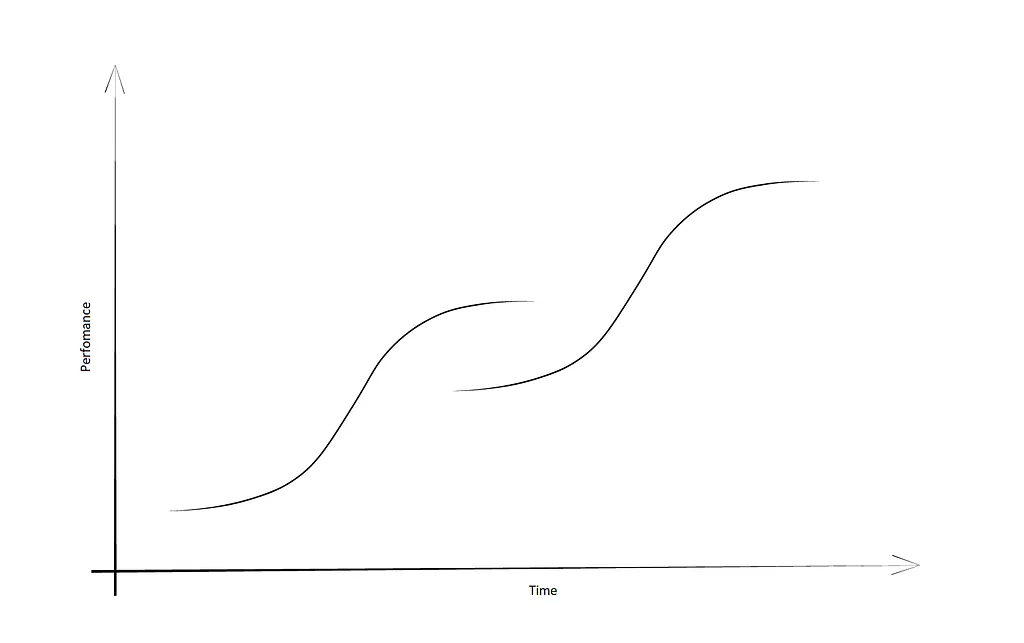
When I first saw these innovation S-curves in a diagram, it changed how I understood technological progress, because the idea is so simple to grasp and accurate at the same time.
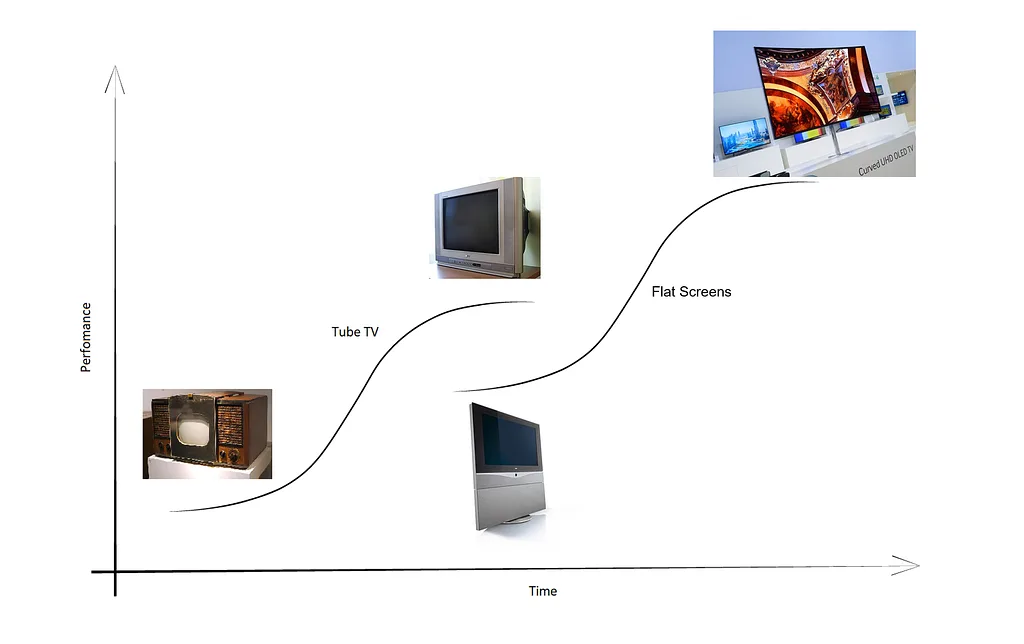
From Tube TVs to LED Smart TVs
Take any example you like, say TVs. At first we had black-and-white tube TVs, which kept getting better with color and teletext. Then flat screens showed up: expensive at first and honestly not better than a good tube TV. But they improved fast and replaced nearly all tube TVs within a few years. Today, flat screens are far superior to anything a tube TV could ever have been. That is what a technological discontinuity looks like, and why it pays to embrace them early.
Traditional cars vs electric cars
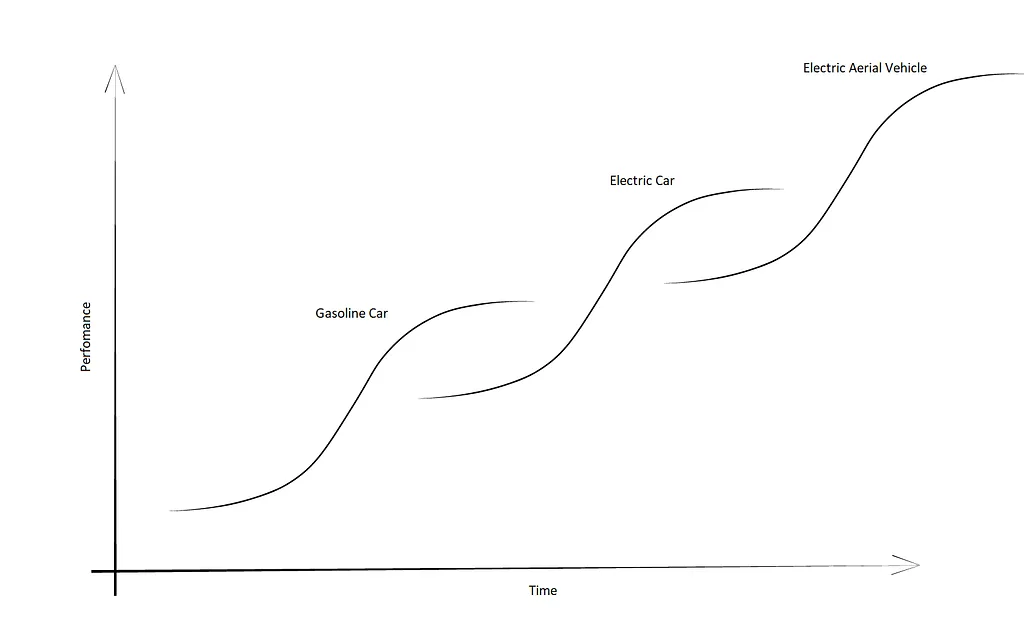
Back to the mobility sector. If you look at electric cars and gasoline cars side by side, you can easily tell where each technology sits on its S-curve.
Internal combustion engines have been optimized for more than 100 years and have reshaped our world like no other technology. But it has become very hard to optimize them further. The performance gains keep shrinking while the effort keeps growing. We are hitting a physical limit. This is the classic maturity phase of a technology.
Electric motors for cars are still quite new in commercial vehicles. We are at the beginning of their S-curve, just before the steep increase in performance. Getting up that slope takes large investments today. That is why it is dangerous to simply ignore electric cars and stick to combustion engines, even if conventional cars are still superior right now. Postpone the investments and you delay the replacement of an old, complicated technology, which means it takes even longer for electric cars to catch up.
This does not mean we should throw all available resources at electric cars. There are other promising technologies that could reshape the future of mobility. But investing large amounts of money into combustion engine development is just not worth the marginal gains anymore.
In my opinion, the initial question of this whole debate is simply wrong. Comparing modern gasoline cars to electric cars at this point in time is an unfair comparison that ignores the future potential of both technologies. The real question is: when will electric cars be superior to conventional cars?
It doesn't matter whether you're a combustion engine enthusiast or a fan of electric cars. What matters is that we invest now in technologies at the beginning of their development cycle, to bring mobility to a sustainable level as soon as possible.
One step further...
Predicting the future is like playing roulette: too many variables can change over time. But look at one drawback of our current transportation system and you realize a big part of it is infrastructure cost. For every car you build, you also have to build roads, traffic lights, gas stations and so on. A more efficient system would not need all of that. That is why I predict EAVs (electric aerial vehicles) will be the next technological step after electric cars, because of their massive advantage in infrastructure costs. Look even closer and you'll see that EAVs and electric cars share many of the same challenges. The biggest ones are regulation, charging time and energy density. Solving these for electric cars transfers the innovations directly to EAVs, making them much more capable and attractive for commercial use. And besides all the logic, the idea that I can fly over my hometown at any time is just pretty cool.
Writing this in 2018 and publishing it in 2021 turned out to be its own small experiment in S-curves. The prediction I was least sure about is the one that has aged best: comparing the two technologies as they stood was always the wrong question. The right one was where each of them sat on its curve, and that answer has not changed.